Standardizing SAP Warehouse Workflows in 2026
The Hidden Problem with SAP Warehouse Inventory Management
Many organizations invest heavily in SAP to manage inventory, warehouse operations, and supply chain execution. Yet despite having a powerful system of record, they often struggle with inconsistent execution on the warehouse floor.
The issue is rarely SAP itself.
The problem is that warehouse workflows frequently evolve differently across facilities, shifts, business units, and individual operators. Over time, inventory processes become dependent on tribal knowledge, workarounds, handwritten notes, excessive manual entry, and operator experience rather than standardized execution. This challenge is becoming increasingly visible in 2026 as organizations seek greater efficiency, resilience, and scalability across their supply chains.
For SAP warehouse operations leaders and supply chain IT managers, the focus is shifting from simply digitizing processes to standardizing how inventory work gets executed.
Why Warehouse Workflows Break Down
Most warehouse environments start with a well-defined process. However, operational reality often introduces variation.
Over time, organizations encounter:
- Site-specific process modifications
- Different operator habits
- Legacy RF and desktop workflows
- Manual exceptions and workarounds
- Varying training methods
- Inconsistent inventory validation practices
What begins as one process frequently turns into dozens of operational variations.
An inventory transfer performed in one warehouse may follow a different sequence than the same transaction performed elsewhere. Receiving procedures may vary by shift. Material replenishment may depend on who is working that day. Exception handling often exists only in the minds of experienced employees.
The result is operational inconsistency that creates friction throughout the supply chain.
The Cost of Manual Warehouse Processes
Many organizations underestimate the financial impact of manual warehouse processes because the inefficiencies occur one transaction at a time.
Common examples include:
Excessive Data Entry
Workers repeatedly enter information that could be captured through barcode scanning or workflow-driven automation.
Additional Process Steps
Legacy RF applications and desktop interfaces often require multiple screens and confirmation steps to complete simple transactions.
Increased Training Requirements
New employees must learn transaction codes, process variations, and undocumented procedures before becoming productive.
Higher Error Rates
When operators make decisions differently, inventory accuracy suffers.
Slower Exception Management
Workers frequently leave mobile workflows to consult supervisors or reference paper instructions when issues arise.
Individually, these delays seem minor. Across thousands of transactions, however, they create significant operational inefficiencies.
Why Desktop-Based Inventory Management Is No Longer Enough
Many SAP environments still rely heavily on desktop-based inventory management processes for activities that should occur at the point of execution.
This creates several challenges:
Delayed Transactions
Inventory movements may occur physically before they are recorded in SAP.
Reduced Visibility
Inventory records become less accurate when updates happen after the fact.
Process Interruptions
Workers must travel between warehouse locations and workstations.
Increased Administrative Work
Information is often captured multiple times across different systems and interfaces.
In fast-moving environments, every additional step affects productivity.
Warehouse teams increasingly need inventory transactions to occur where work happens, not after operators return to a desk.
How Logistics Process Delays Impact the Entire Supply Chain
Logistics process delays rarely stay isolated within the warehouse.
A delayed inventory update can create downstream disruptions that affect:
- Production schedules
- Material availability
- Transportation planning
- Customer fulfillment
- Inventory accuracy
- Operational reporting
When frontline execution becomes inconsistent, the business loses trust in its operational data.
This is particularly problematic for organizations managing complex SAP environments across multiple plants, warehouses, distribution centers, or manufacturing facilities.
The larger the operation becomes, the more critical warehouse workflow standardization becomes.
Manufacturing Throughput Depends on Standardized Execution
For manufacturers, inventory execution directly affects manufacturing throughput.
Production lines depend on materials arriving:
- In the correct quantity
- At the correct location
- At the correct time
When warehouse workflows vary by operator or facility, production disruptions become more likely.
Common issues include:
- Delayed material staging
- Inventory discrepancies
- Stock shortages
- Incorrect replenishment
- Work-in-process visibility challenges
Manufacturing leaders increasingly recognize that standardized inventory execution is not merely a warehouse initiative. It is a production efficiency initiative.
Every process improvement that reduces friction in inventory management helps improve overall plant performance.
What Warehouse Workflow Standardization Actually Means
Many organizations hear the term “standardization” and assume it means creating more procedures.
In reality, warehouse workflow standardization means embedding best-practice execution directly into the workflow itself.
Instead of relying on workers to remember every step, the process guides execution.
This includes:
- Guided process sequencing
- Embedded business rules
- Automated validations
- Standard exception handling
- Scan-first data capture
- Consistent user experiences
The goal is not to make workers adapt to technology.
The goal is to make technology guide workers through optimal execution.
The Role of Mobile Execution in Modern SAP Warehouses
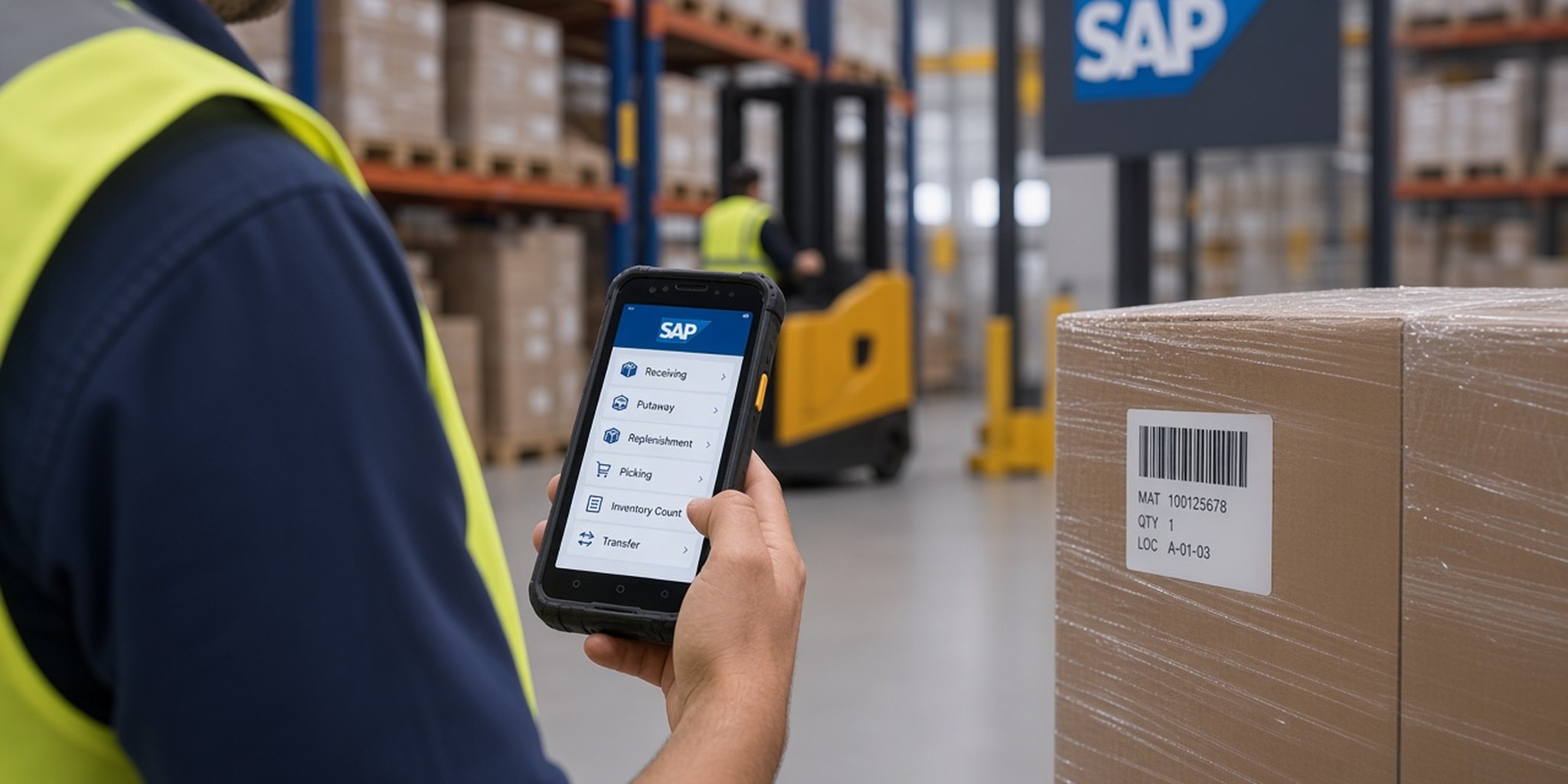
Modern mobile execution platforms are changing how organizations approach SAP warehouse inventory management.
Rather than simply presenting SAP screens on mobile devices, newer approaches focus on workflow orchestration and guided execution. This aligns with the growing need to standardize execution, reduce manual workarounds, and simplify inventory transactions. Organizations increasingly view SAP as the system of record while mobile execution layers govern how work is performed on the warehouse floor. This approach helps standardize workflows, validation logic, sequencing, and exception handling across facilities and operators.
Modern mobile workflows commonly support:
- Barcode-driven execution
- Real-time inventory updates
- Standardized process flows
- Reduced manual entry
- Simplified training
- Offline operational continuity
Instead of requiring workers to learn SAP transaction codes or navigate complex interfaces, execution can be simplified and standardized around operational tasks.
Characteristics of a Standardized SAP Warehouse Operation
Organizations that successfully standardize warehouse execution often share several characteristics.
Consistent Processes Across Sites
Receiving, putaway, replenishment, picking, transfers, and inventory counting follow the same business logic regardless of location.
Guided Operator Experiences
The workflow determines the next step rather than relying on memory or experience.
Scan-First Execution
Barcode scanning replaces unnecessary typing and manual entry wherever possible.
Embedded Validation Rules
Errors are prevented before transactions are completed.
Reduced Training Requirements
New employees become productive faster because workflows guide execution.
Real-Time Inventory Visibility
Transactions occur at the point of work rather than later through batch updates or desktop systems.
Why 2026 Is a Turning Point
Several trends are converging in 2026:
- Continued SAP S/4HANA adoption
- Workforce turnover and labor shortages
- Increasing demands for inventory accuracy
- Supply chain resilience initiatives
- Greater use of warehouse automation technologies
- Growing expectations for modern user experiences
Organizations can no longer depend on operator knowledge as the primary mechanism for process control.
Operational consistency must be built into the workflow.
As warehouses become more connected and automated, standardized execution becomes the foundation that enables future improvements in SAP warehouse automation, analytics, AI-driven operations, and advanced data capture technologies.
Conclusion
The future of SAP warehouse inventory management is not simply about mobility, automation, or modernization.
It is about standardization.
Organizations that continue relying on desktop-based inventory management, manual warehouse processes, and operator-dependent execution will struggle with inefficiency, training challenges, and operational inconsistency.
The companies creating competitive advantages in 2026 are standardizing workflows across facilities, embedding business logic into execution processes, and enabling workers with mobile experiences that reduce complexity at the point of work.
When every operator follows the same optimized process, inventory becomes more accurate, logistics become more predictable, and manufacturing throughput improves.
That is why warehouse workflow standardization is quickly becoming one of the most important priorities for SAP warehouse operations leaders today.
Frequently Asked Questions About SAP Warehouse Inventory Management
Want even more reading?
Why a Mobile-First Approach to SAP Warehouse Execution Is Essential