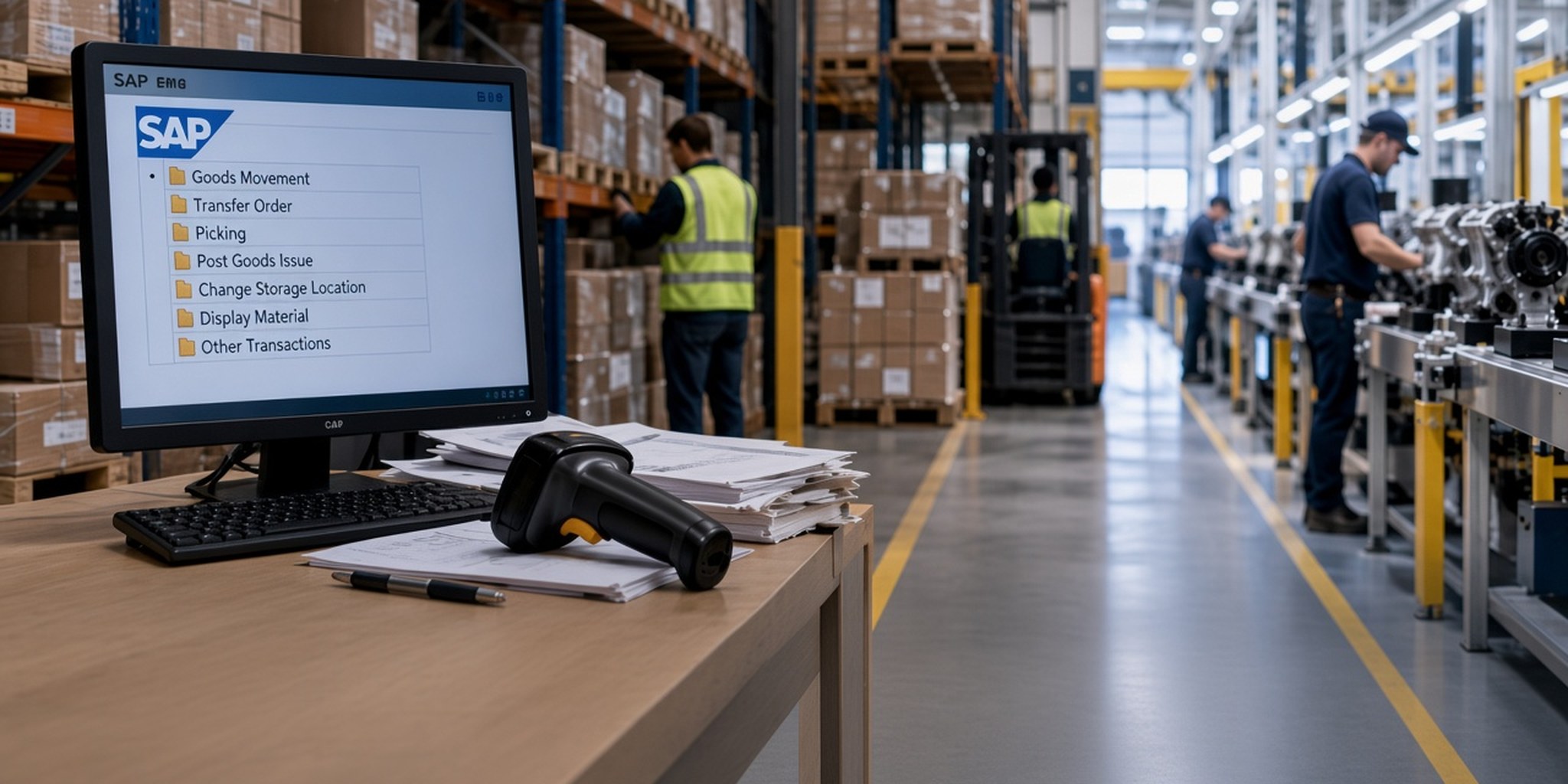
Manual SAP Warehouse Bottlenecks in Manufacturing
Manufacturing organizations spend millions optimizing production lines, equipment utilization, and supply chain operations. Yet many overlook one of the biggest constraints on manufacturing throughput: the warehouse.
In many SAP environments, warehouse teams still rely on manual warehouse processes to execute picking, staging, replenishment, inventory transfers, and production support activities. Workers navigate multiple SAP screens, manually enter data, memorize transaction sequences, and depend on experience to complete routine tasks.
These processes may seem manageable in isolation. However, when multiplied across thousands of daily warehouse transactions, they create bottlenecks that slow inventory movement, delay production, reduce efficiency, and ultimately impact the factory floor.
The good news is that manufacturers no longer need to accept these limitations. Modern SAP-native mobile workflows are transforming warehouse execution by eliminating friction, standardizing processes, and accelerating inventory operations. As organizations focus on SAP warehouse process optimization, many are discovering that warehouse execution improvements can deliver some of the fastest operational gains across the entire manufacturing enterprise.
The Warehouse Is Often the Hidden Constraint
Manufacturing leaders typically focus on production equipment when investigating throughput issues.
When output slows, attention often shifts to machinery, labor availability, production scheduling, or material planning.
However, many manufacturing delays actually originate upstream in warehouse operations.
Consider how many critical activities depend on warehouse execution:
- Raw material receiving
- Inventory transfers
- Component picking
- Production staging
- Line-side replenishment
- Work-in-process movement
- Finished goods handling
- Shipping preparation
When these activities become slow or inconsistent, production lines are forced to wait for materials, supervisors spend time resolving shortages, and planners lose confidence in inventory accuracy.
In other words, warehouse bottlenecks quickly become manufacturing bottlenecks.
Where Manual SAP Warehouse Processes Create Delays
Most SAP warehouse teams have identified opportunities to improve efficiency, but many continue operating with workflows that contain unnecessary manual effort.
Several common bottlenecks appear repeatedly across manufacturing environments.
Manual Data Entry
Workers often spend significant time entering quantities, locations, batch numbers, and material information into SAP.
Every manual entry increases transaction time and creates opportunities for mistakes.
Even small errors can trigger inventory discrepancies that require additional investigation and correction later.
The result is slower warehouse execution and reduced productivity.
Excessive Screen Navigation
Traditional warehouse transactions frequently require employees to move through multiple screens to complete a single task.
Instead of focusing on material movement, warehouse personnel spend valuable time navigating systems.
These extra touches accumulate across shifts, departments, and facilities, creating a substantial productivity drain.
Knowledge-Based Process Execution
Many warehouse operations depend heavily on employee experience.
Veteran workers know which transaction to use, what exceptions to watch for, and how to recover from common errors.
New employees often struggle to achieve the same level of efficiency.
This dependency on tribal knowledge creates inconsistency across operators, shifts, and locations.
Manual Exception Handling
Exceptions are inevitable in warehouse operations.
Missing inventory, incorrect quantities, damaged materials, and location issues all require resolution.
In many environments, exception handling relies on phone calls, paper notes, emails, or supervisor intervention.
The result is additional delays that disrupt inventory flow and consume valuable labor resources.
How Picking Bottlenecks Impact Manufacturing Throughput
Picking is one of the most important warehouse activities supporting manufacturing operations.
When picker productivity slows, production schedules suffer.
Common picking bottlenecks include:
- Searching for inventory
- Manually confirming materials
- Entering transaction data
- Correcting picking mistakes
- Managing inventory discrepancies
Each delay extends the time required to get materials from storage locations to production lines.
When hundreds or thousands of picks occur every day, the cumulative impact on manufacturing throughput becomes significant.
Production teams are often forced to compensate by carrying larger inventory buffers, increasing safety stock, or creating manual workarounds that add cost without adding value.
Staging Delays Create Production Line Risk
The staging process is designed to ensure production materials are ready when needed.
Unfortunately, manual warehouse processes often create friction that delays staging activities.
Warehouse workers may need to:
- Verify multiple system records
- Re-enter transaction information
- Confirm inventory manually
- Resolve material discrepancies
- Coordinate across departments
The more manual steps involved, the greater the risk of delays.
Late staging means materials arrive later at work centers, increasing the likelihood of production interruptions and schedule changes.
For manufacturers focused on production efficiency, improving staging execution can generate immediate operational benefits.
Inventory Movement Bottlenecks Reduce Visibility
Inventory movement is more than a physical process.
It is also an information process.
Operations leaders depend on SAP warehouse management systems to understand where inventory is located and how it is being used.
When inventory movements rely on delayed confirmations or manual updates, visibility suffers.
This can result in:
- Inventory inaccuracies
- Material shortages
- Planning disruptions
- Excess cycle counting
- Increased safety stock
Manufacturers frequently discover that inventory issues are not caused by SAP itself, but by the manual execution methods used to record warehouse activity.
Improving execution quality often improves inventory accuracy at the same time.
Why More Automation Alone Isn’t Enough
Many organizations pursue warehouse automation initiatives through scanners, mobile devices, conveyors, robotics, or automated storage technologies.
While these investments can provide significant value, automation alone does not eliminate warehouse friction.
If workers still follow inefficient workflows, navigate unnecessary screens, and manually determine the next step in the process, bottlenecks will remain.
The greatest opportunity often comes from optimizing the workflow itself.
Effective SAP warehouse process optimization focuses on:
- Reducing process complexity
- Eliminating unnecessary actions
- Standardizing execution
- Automating validation
- Guiding users through tasks
- Preventing errors before they occur
The objective should be simpler execution, not simply faster technology.
The Rise of SAP-Native Mobile Workflows
Forward-looking manufacturers are increasingly replacing legacy warehouse execution methods with modern SAP-native mobile workflows.
Rather than forcing workers to interact directly with complex SAP transactions, these solutions deliver streamlined, task-based experiences optimized for frontline execution.
Operators are guided through the process step by step.
Business rules are embedded directly within workflows.
Validation occurs automatically.
Scanning replaces manual entry whenever possible.
As a result, warehouse activities become faster, more consistent, and easier to execute.
Most importantly, organizations remove operational variability that frequently causes bottlenecks.
How H1 Eliminates Warehouse Friction
H1 (Havensight Inventory One) was designed specifically to address warehouse execution challenges within SAP environments.
Instead of acting as another layer of complexity, H1 functions as a warehouse execution layer that simplifies how warehouse work gets done.
H1 helps manufacturers:
- Reduce manual data entry
- Eliminate unnecessary process steps
- Simplify inventory transactions
- Standardize workflows across facilities
- Improve inventory accuracy
- Accelerate picking and staging activities
- Enable scan-first execution
- Reduce training requirements
- Improve production support processes
By providing system-guided workflows, H1 helps ensure work is executed consistently regardless of experience level, shift, or location.
The result is a more efficient warehouse operation that supports manufacturing goals rather than slowing them down.
The Business Impact of Removing Warehouse Bottlenecks
When warehouse execution becomes faster and more predictable, benefits extend well beyond the warehouse.
Manufacturers frequently experience:
- Improved manufacturing throughput
- Faster material replenishment
- Increased production efficiency
- Better inventory accuracy
- Reduced labor waste
- Lower training costs
- Faster transaction execution
- Greater operational consistency
Instead of spending time correcting errors and managing exceptions, warehouse teams can focus on moving material efficiently and supporting production objectives.
This creates a stronger connection between warehouse performance and manufacturing success.
The Future of Manufacturing Warehouse Operations
Manufacturing leaders are under constant pressure to do more with less.
Improving manufacturing throughput no longer depends solely on production equipment and scheduling improvements. It also depends on eliminating the operational friction that slows material movement throughout the warehouse.
Manual warehouse processes create delays at nearly every stage of inventory execution, from picking and staging to scanning and inventory movement. Those delays impact production schedules, inventory accuracy, and overall operational performance.
Modern SAP-native mobile workflows provide a better path forward.
By simplifying execution, embedding process intelligence, and reducing manual effort, solutions like H1 help manufacturers optimize warehouse operations, improve production support, and unlock higher levels of throughput without replacing SAP.
When warehouse execution becomes faster, simpler, and more consistent, the entire manufacturing organization benefits.
Frequently Asked Questions About SAP Warehouse Process Optimization
Read Next:
Why a Mobile-First Approach to SAP Warehouse Execution Is Essential
Want even more reading?
SAP EWM Mobile Barcode Scanning Options Compared: Personas, ITS Mobile, and Havensight Inventory One (H1)